

Business News CMT Welcomes important guidance on two-strokes
페이지 정보
작성자 최고관리자 댓글 0건 조회 48회 작성일 26-02-03 12:29본문
CMT Welcomes important guidance on two-strokes
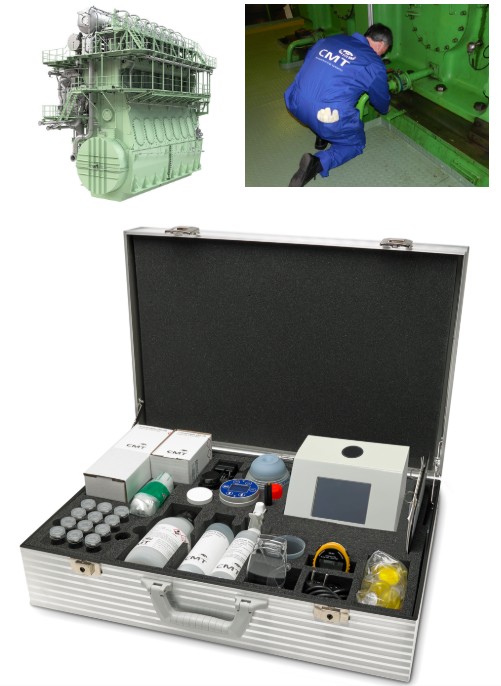
CMT says new drain oil guidance reflects a fundamental change in how two-stroke engines are being operated in service
Germany’s CM Technologies (CMT) has welcomed an important clarification from marine engine builder Everllence on how to properly monitor, manage and interpret the cylinder condition of large two-stroke marine diesel engines.
Service Letter SL2025-776/NHN, distributed to engine operators towards the end of last year, sets out new guidelines for iron content and residual base number (BN) in scavenge drain oil, alongside clarified sampling procedures, recommended analysis intervals, and defined corrective actions for normal, abnormal and alert wear conditions. The guidance applies to Everllence B&W MC/MC-C and ME/ME-C two-stroke engines operating on all fuel types.
CM Technologies said the November 2025 guidance reflects a fundamental change in how two-stroke engines are now being operated in service. “What has changed is the way engines are being operated,” said David Fuhlbrügger, CMT’s Joint Managing Director.
“Two-stroke engines are now running much closer to their lubrication limits, largely because of fuel variability and the drive to reduce cylinder oil consumption. The new guidance recognises that optimisation has to be backed up by proper monitoring, sound interpretation of the data and clear corrective actions when wear levels move out of range.”
A central element is the requirement to interpret drain oil results in context. Everllence advises that measured iron values must be corrected to a reference cylinder oil feed rate and assessed alongside fuel sulphur content and residual BN. This helps distinguish between corrosive, abrasive and adhesive wear mechanisms, since system-oil dilution can artificially lower both iron and BN readings, creating misleading results if not identified.
“The key take-away here is that low numbers alone are not enough,” Fuhlbrügger said. “If iron values are not corrected for feed rate, or dilution effects are not identified, actual wear rates can be masked, which can lead to insufficient lubrication and accelerated wear of piston rings and cylinder liners before the condition is recognised.”
The service letter reinforces that onboard scavenge drain oil analysis is intended as a supplement to accredited laboratory testing, providing an operational early-warning function between scheduled laboratory analyses, which Everllence specifies at intervals of 1500 running hours or three months.
“Without regular scavenge drain oil testing, operators lose an early-warning mechanism that Everllence identifies as essential for detecting abnormal wear before it becomes a potentially catastrophic and very costly problem,” Fuhlbrügge added.
CM Technologies’ suite of Cylinder Drain Oil Management solutions are designed to support this monitoring layer by enabling frequent onboard assessment of key parameters, including iron content and remaining alkalinity. Used alongside laboratory analysis, these tools help crews and technical managers identify developing trends, verify the effect of feed-rate adjustments and decide when escalation to laboratory testing or further investigation is required.
The Everllence guidance also addresses high-sulphur fuel operation through defined sweep-test procedures, underlining that lubrication optimisation under corrosive conditions must be validated through structured testing rather than assumed settings.
“Better understanding of the total iron content in scavenge drain oil, lends itself to better understanding of the combined effects of corrosive, abrasive and adhesive wear on the cylinder liners and piston rings. Certainly, when engines operate on high-sulphur fuels, lubrication settings must be validated rather than assumed.”
The new guidance points to a paradigm shift in engine optimisation methodology, moving more towards a controlled, evidence-based process,” furthered Fuhlbrügge. “It reinforces the importance of systematic condition monitoring in extending component life and supporting responsible engine management, particularly where operators are seeking to optimise lubrication without compromising reliability.”
■ Contact: CMT https://cmtechnologies.de/en